Trump Unveils Daring Framework for Future Greenland and Arctic Deal Following NATO Talks
Trump Unveils Daring Framework for Future Greenland and Arctic Deal Following NATO Talks
In a major geopolitical development announced from Davos, Switzerland, President Donald Trump revealed that the United States and NATO leadership have reached a framework for a future deal involving Greenland and the broader Arctic region. The announcement, made via Truth Social, signals a significant shift from confrontation toward negotiation—one with major implications for global security, trade, and Arctic strategy.
This announcement marks a pivotal moment as Trump unveils daring frameworks that could redefine international relations in the region.
The framework emerged after what Trump described as a “very productive meeting” with Mark Rutte, NATO’s Secretary General, during the World Economic Forum in Davos. While no final agreement has been consummated, Trump characterized the framework as a strong starting point that could benefit both the United States and NATO allies.
A Strategic Pause: Tariffs Put on Hold
One immediate and tangible outcome of the announcement is Trump’s decision to halt tariffs previously scheduled to take effect on February 1st. The tariffs, which had been a source of concern for markets and international partners alike, were paused explicitly because of the progress made in Greenland-related negotiations.
“Watch your 401K,” Trump wrote—an unmistakable signal that the administration is factoring economic stability and market confidence into its foreign policy calculus. Early reaction from Davos suggested markets welcomed the news, viewing the pause as a sign of de-escalation and constructive diplomacy.
Greenland, NATO, and Arctic Security
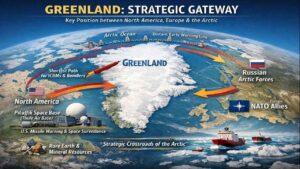
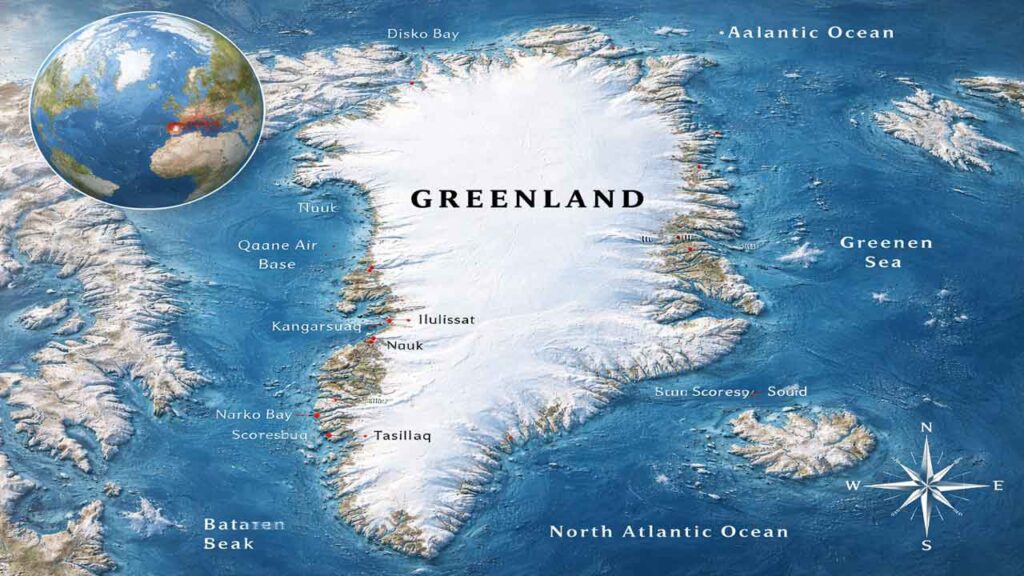
At the heart of the framework is Greenland’s strategic importance in the Arctic, a region increasingly central to global security due to climate change, new shipping routes, and heightened interest from Russia and China.
Although European Union officials reiterated that Greenland is not for sale, the Trump administration has carefully reframed the discussion. Rather than focusing on ownership, U.S. officials are emphasizing security cooperation, infrastructure investment, and defense responsibilities—areas where Washington argues it is uniquely positioned to lead.
Administration officials have repeatedly stated that the United States is best equipped to defend Greenland should tensions escalate with Russia or China, both of which have expanded Arctic activity in recent years. Trump has also argued that Denmark has not adequately invested in Greenland’s long-term security or infrastructure, creating space for a broader NATO-led solution.
The “Golden Dome” and Arctic Defense
Trump’s statement also referenced ongoing discussions around the “Golden Dome”, believed to involve missile defense, radar coverage, or strategic monitoring systems tied to Greenland’s location. While details remain limited, Greenland’s geography makes it a critical node for early-warning systems and Arctic defense architecture.
Any such initiative would likely be framed within NATO rather than as a unilateral U.S. move—an approach that could ease European concerns while strengthening collective defense.
Who’s at the Negotiating Table
Trump named a high-level negotiating team that will spearhead discussions moving forward:
-
J.D. Vance
-
Marco Rubio
-
Steve Witkoff
The team will report directly to Trump, underscoring the importance of the negotiations within the administration’s broader foreign policy agenda. Additional officials may be brought in as needed, signaling flexibility and seriousness in the process.
Europe’s Response: Cautious but Engaged
Reporting from Davos, journalists noted that European Union officials expressed a willingness to start from a place of negotiation, even while firmly rejecting any outright sale of Greenland. This marks a subtle but meaningful shift: while ownership is off the table, cooperation is not.
NATO Secretary General Rutte has been described as urging “cooler heads to prevail,” positioning NATO as a stabilizing force and mediator rather than a bystander. Trump himself highlighted Rutte’s supportive posture, including a note passed to him backing Trump’s push to address Greenland’s long-term security needs.
Trump’s Negotiation Style on Display
Observers noted that this episode reflects a familiar Trump strategy: talk big, force the issue into public view, then negotiate. By elevating Greenland to the global stage, Trump compelled NATO allies and EU leaders to engage directly with a topic that had long simmered beneath the surface.
Now, with a framework in place, negotiations can begin in earnest—focused not on territorial transfer, but on defense responsibilities, economic investment, and Arctic stability.
Why This Matters to Americans
For U.S. audiences, including readers in Oklahoma and across the heartland, the Greenland framework may feel distant—but its implications are not. Arctic security affects global energy markets, shipping routes, military readiness, and economic stability. The decision to pause tariffs alone has direct consequences for retirement accounts, trade-dependent industries, and inflation pressures at home.
More broadly, the announcement underscores how national security, diplomacy, and economic policy are increasingly intertwined.
A Starting Point, Not a Finish Line
Trump was clear that this is only a framework, not a final deal. “Further information will be made available as discussions progress,” he said—leaving open the shape and scope of what may eventually emerge.
Still, the message from Davos was unmistakable: the United States and NATO are now aligned on beginning serious negotiations over Greenland and the Arctic—without tariffs, without ultimatums, and with global markets watching closely.
#Greenland #ArcticSecurity #NATO #TrumpForeignPolicy #GlobalMarkets
First Look: $121 Million MAPS 4 Stadium Set to Spark New OKC Sports & Entertainment District
Trump Economist Predicts “Biggest Refund Season Ever” in 2026