US Critical Infrastructure Faces Growing Cyber Threat as Experts Warn PLC Defenses Fall Short
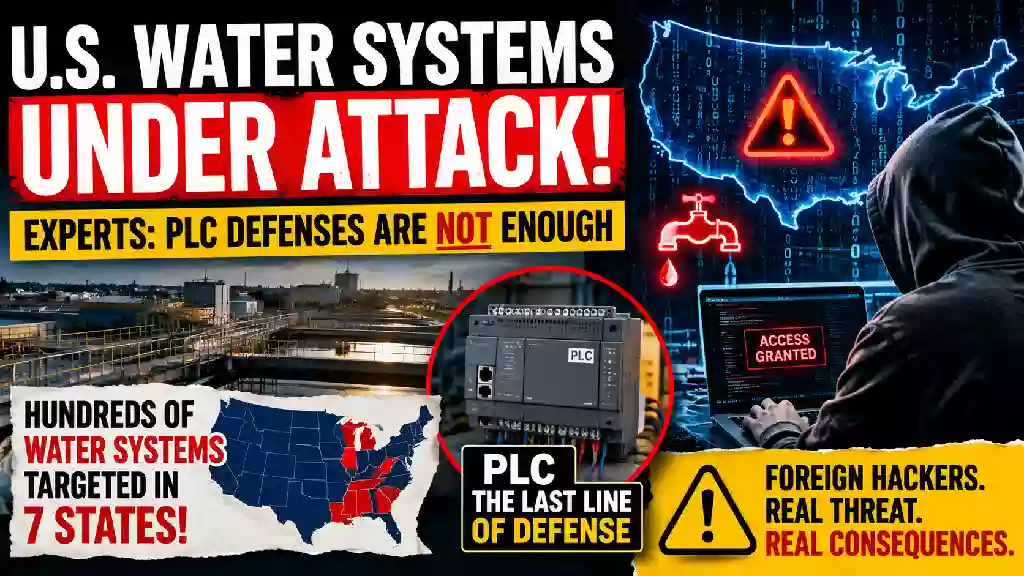
U.S. water systems face growing cyber threats as experts warn that vulnerable PLCs may not be adequately protected.
US Critical Infrastructure Faces Growing Cyber Threat as Experts Warn PLC Defenses Fall Short
US Critical Infrastructure at Risk as Cyber Experts Warn PLC Defenses Are Not Enough
America’s critical infrastructure is facing an increasingly serious cybersecurity challenge as hackers target water systems and other essential services. A cybersecurity expert is warning that the United States still lacks sufficient technology and protection to defend some of the programmable logic controllers, or PLCs, that control critical physical operations.
The warning comes as hundreds of water systems were reportedly targeted across seven states during July, intensifying concerns about the vulnerability of America’s water supply and other critical infrastructure.
PLCs Could Become a Critical Weak Point
Programmable logic controllers are specialized computers used to control physical equipment and industrial processes. In critical infrastructure, they can operate pumps, valves and other machinery that keeps essential systems functioning.
Cybersecurity expert Morgan Wright described PLCs as a crucial line of defense because they can control operations involving water flow, chemical releases and other potentially dangerous physical processes.
Unlike a conventional cyberattack that might temporarily lock someone out of a computer or steal digital information, an attack against operational technology can potentially affect the physical world.
That makes PLC cybersecurity a growing national security concern.
Legacy Technology Creates New Cybersecurity Risks
One of the biggest challenges is that many PLCs are older, legacy systems that were not originally designed to withstand today’s internet-connected cyber threats.
Wright said the United States has not developed enough technology to defend these operational technology systems effectively. He also warned that attackers can scan for vulnerable devices and identify their digital fingerprints.
That creates a potentially dangerous chain reaction: if hackers discover one vulnerable system, similar devices using the same technology could also become targets.
The problem is particularly concerning because critical infrastructure facilities can be located far from major population centers while still maintaining internet-connected communications.
Remote Water Systems Can Still Be Reached
Some remote infrastructure systems rely on cellular modems to communicate with networks. Although these facilities may be physically isolated, their network connections can potentially expose them to attackers located anywhere in the world.
Wright explained that the internet has no meaningful concept of physical distance. An attacker overseas could potentially scan for exposed devices and attempt to reach them through an internet-connected modem.
Once compromised, PLC-controlled equipment could potentially affect physical processes such as opening and closing valves or controlling pumps.
That is why cybersecurity experts increasingly view operational technology security as a critical component of national infrastructure protection.
Foreign Cyber Threats Raise National Security Concerns
The attacks are also raising questions about the involvement and objectives of foreign adversaries. The source material does not establish that a single country was responsible for all of the reported incidents, but Wright discussed different approaches associated with China and Iran.
He characterized China’s activities as more focused on intelligence collection, visibility and positioning vulnerabilities for potential future use, while describing Iran as more associated with destructive objectives.
The broader concern is that cyberattacks against infrastructure can provide adversaries with valuable information about how essential American systems operate.
Even when an attack does not cause major physical damage, gaining access to infrastructure networks could provide intelligence that becomes valuable during a future geopolitical crisis.
Artificial Intelligence Could Lower the Barrier for Hackers
Artificial intelligence is adding another layer to the cybersecurity challenge.
According to Wright, AI is not necessarily creating entirely new methods of hacking these systems. Instead, it is reducing the amount of time and specialized expertise needed to understand equipment and exploit existing weaknesses.
That could make sophisticated cyberattacks accessible to a much wider group of individuals.
Wright said automated attacks have already demonstrated how technology can reduce the technical knowledge required to launch cyber operations.
As AI tools become more capable, cybersecurity professionals face the challenge of developing defenses quickly enough to keep pace.
Private Sector Plays Major Role in Infrastructure Security
Protecting America’s critical infrastructure will require cooperation between government agencies and private companies.
The source notes that approximately 80% to 85% of critical infrastructure is privately owned, while water systems are often operated by municipalities.
That makes public-private cybersecurity partnerships particularly important.
The warning is also not new. Wright pointed to federal efforts dating back to 1998 aimed at protecting critical infrastructure, arguing that significant cybersecurity challenges remain decades later.
The Cybersecurity Challenge Is Becoming More Urgent
The combination of aging PLC technology, internet-connected operational systems, foreign cyber threats and increasingly accessible AI tools presents a difficult challenge for U.S. infrastructure operators.
Water supplies, power systems and other essential services cannot afford to treat cybersecurity as an afterthought. As attackers become better at finding vulnerable devices, protecting the technology responsible for controlling physical infrastructure will become increasingly important.
For cybersecurity experts, the message is clear: America’s critical infrastructure needs stronger defenses before today’s vulnerabilities become tomorrow’s national emergency.
#Cybersecurity #CriticalInfrastructure #PLCSecurity #CyberAttack #WaterSystems #CyberDefense #AISecurity #OperationalTechnology #InfrastructureSecurity #NationalSecurity #CyberThreats