Bill Gates Sounds the Alarm on AI: ‘Turbulent Era’ Raises Fears Over Jobs Cyberattacks and Bioterrorism
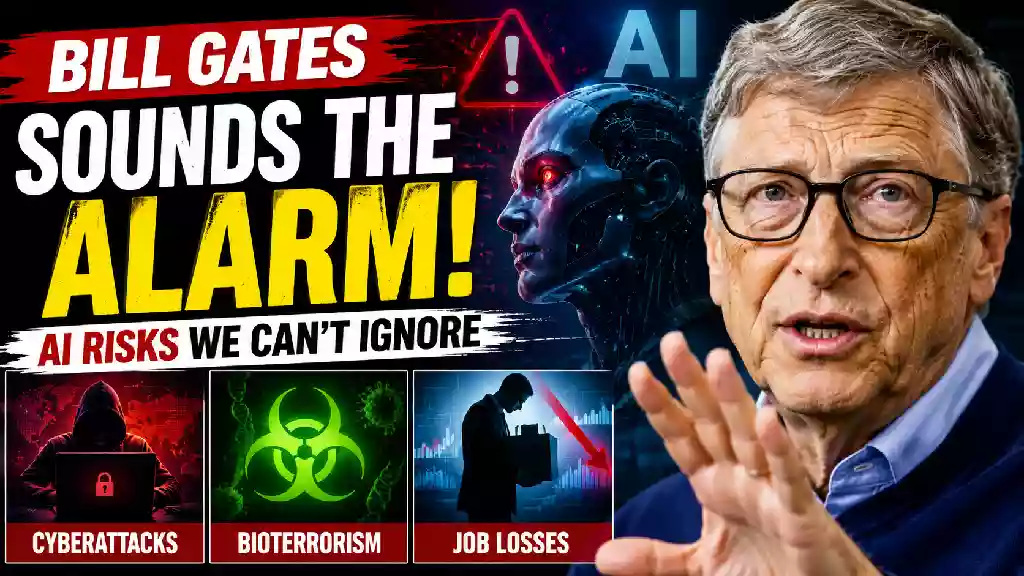
Bill Gates sounds the alarm over rapidly advancing artificial intelligence, warning about potential cyberattacks, bioterrorism risks and major disruptions to jobs and society.
Bill Gates Sounds the Alarm on AI: ‘Turbulent Era’ Raises Fears Over Jobs Cyberattacks and Bioterrorism
Bill Gates Warns AI Is Advancing Faster Than Society Can Control
Artificial intelligence is advancing at a pace that even some of the technology industry’s most influential pioneers say is becoming difficult to manage. Microsoft co-founder Bill Gates has issued a stark warning that increasingly powerful AI systems could create serious threats ranging from cyberattacks and bioterrorism to widespread job displacement.
Gates says AI has become dramatically more capable over the past year—faster than he expected—and argues that governments and technology companies have not developed adequate safeguards to keep up with the technology’s rapid evolution.
The warning comes as AI continues moving beyond chatbots and productivity tools into coding, cybersecurity, medicine, manufacturing and other areas of the economy.
Bill Gates Warns of Dangerous AI Capabilities
Gates specifically identified cyberattack and bioterrorism risks as major concerns.
The concern is that AI could give individuals with relatively limited expertise access to capabilities that previously required highly specialized knowledge. Gates has argued that AI-enabled fraud, deepfakes, cyberattacks and other forms of digital abuse could become increasingly difficult to contain.
In the source discussion, Gates also questioned whether the current systems used to evaluate advanced AI models are sufficient to identify and minimize dangerous capabilities.
That raises a critical question: Are AI systems becoming more powerful faster than governments can establish meaningful safety rules?
AI Could Reshape the Global Job Market
The risks extend beyond cybersecurity.
Gates and other technology experts are increasingly concerned about the impact of AI on employment. Advanced AI could perform tasks across industries that have traditionally required human workers, creating the possibility of significant job displacement.
The source discussion points to artificial general intelligence, or AGI, as a potential turning point. AGI generally refers to AI capable of performing a broad range of economic tasks at human-level or better performance.
If AI systems eventually reach that level of capability, the effects could reach far beyond the technology sector.
Law, customer service, software development, medicine, manufacturing and other industries could all face major changes as businesses look for ways to automate increasingly sophisticated work.
Gates’ broader argument is that this transition could happen much faster than previous technological revolutions. Recent reporting on his new AI essay says he believes traditional comparisons with earlier technological changes underestimate the speed and scale of AI-driven disruption.
The AI Regulation Debate Gets More Complicated
One of the biggest challenges is finding the right balance between AI regulation and technological innovation.
Some policymakers and technology leaders argue that stronger safeguards are necessary. Others warn that overly aggressive regulation could slow American AI development and allow China to gain a technological advantage.
That tension is highlighted in the source material, where Roberts argues that the United States faces a difficult choice: manage AI’s dangers while ensuring the country does not fall behind China’s rapidly developing AI capabilities.
The result is a difficult policy dilemma.
Governments want to prevent dangerous uses of AI, but they also want companies to continue developing advanced systems that could produce economic, scientific and national-security benefits.
Gates Rejects Relying Only on Industry Self-Regulation
Gates has become increasingly critical of the idea that AI companies should be responsible for policing themselves.
His argument is that the stakes are too high to rely exclusively on voluntary industry standards.
Recent reporting on Gates’ new AI proposals says he wants stronger national and international oversight, including clear criteria for monitoring extreme risks such as biological threats.
The source discussion similarly raises concerns about relying on voluntary safeguards for increasingly powerful AI systems.
That puts pressure on lawmakers to determine what types of AI development should require government oversight and what kinds of applications should be regulated.
Deepfakes Are Already a Major Concern
Not every AI threat is theoretical.
AI deepfakes have already become a major concern because increasingly convincing synthetic images, audio and videos can be used to deceive people.
The source material specifically discusses regulating harmful AI applications, including deepfakes designed to impersonate people or place individuals in compromising situations.
That approach could allow governments to target harmful uses of AI without necessarily restricting the development of the underlying technology.
Are Data Centers Distracting From the Bigger AI Debate?
The growing controversy over AI data centers has also become part of the larger technology debate.
Communities have raised concerns about the construction of massive facilities needed to power AI systems. But the source discussion suggests that opposition to data centers may represent something broader: public unease about the rapid expansion of artificial intelligence itself.
The bigger question is not simply where AI infrastructure should be built.
It is whether society is prepared for what increasingly capable AI systems could mean for employment, national security, privacy, misinformation and human relationships.
The Future of AI May Depend on Decisions Made Now
Bill Gates is not arguing that artificial intelligence should simply be abandoned. Instead, his warning is centered on preparation.
AI could deliver enormous benefits in healthcare, science, education and other fields. But those benefits will come alongside serious risks if governments and technology companies fail to establish effective safeguards.
Gates’ latest warning represents a significant shift in tone from his earlier optimism about AI. He now argues that society needs to confront the technology’s risks with the same urgency being applied to its potential benefits.
The AI race is accelerating, and the United States and China are competing for technological leadership. But the central challenge may be bigger than which country wins.
The real question is whether humanity can develop artificial intelligence quickly enough to capture its benefits without allowing its most dangerous capabilities to outrun the safeguards designed to control them.
#BillGates #AI #ArtificialIntelligence #AIWarning #AISafety #AIRegulation #AGI #Cybersecurity #CyberAttack #Bioterrorism