90 Americans Missing After Nepal Floods as Glacier Collapse Devastates Border Region
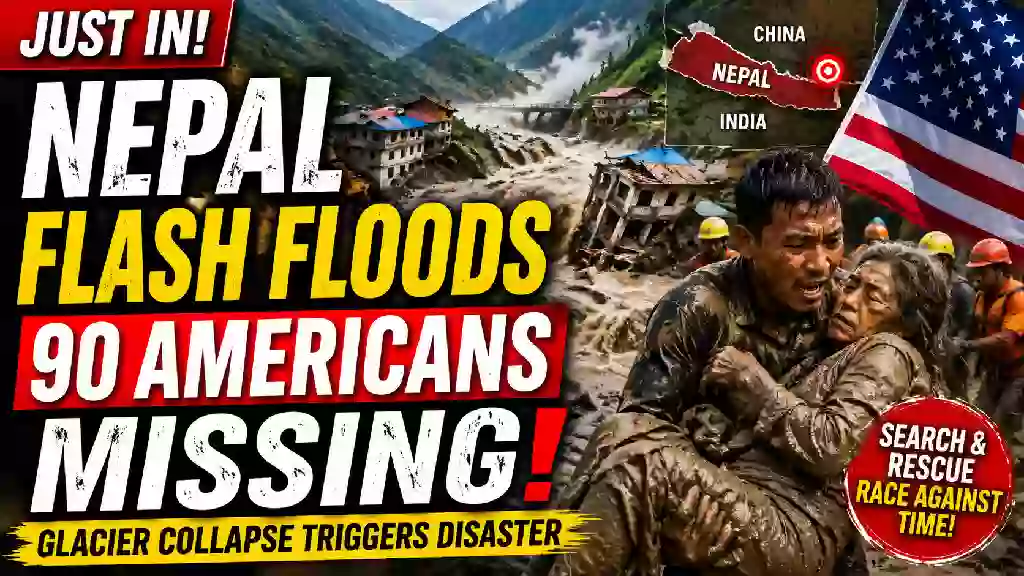
Nepal flash floods devastate communities near the China-Nepal border after a glacier collapse triggers a massive surge of water and debris, as rescue teams race to locate missing people, including approximately 90 Americans.
90 Americans Missing After Nepal Floods as Glacier Collapse Devastates Border Region
Nepal Flash Flood Disaster: 90 Americans Unaccounted for as Deadly Glacier Collapse Triggers Massive Rescue
A devastating flash flood disaster in Nepal and Tibet has sparked an urgent international search-and-rescue operation after torrents of water, mud, ice and debris tore through communities near the China-Nepal border.
U.S. officials said about 90 Americans remained unaccounted for, while hundreds of people have died and more than 1,000 others remain missing across the affected region. Three Americans had been rescued, and officials said they were not aware of any U.S. deaths at the time of the latest reports.
The disaster has left families around the world desperately waiting for information as rescuers race into heavily damaged mountain communities.
Massive Floods Sweep Through Himalayan Communities
The flooding struck with extraordinary speed, overwhelming areas along mountain rivers and valleys. Homes, vehicles, roads and bridges were swept away as powerful torrents carrying enormous amounts of mud and debris moved downstream.
The source material describes scenes of survivors covered in mud being carried to safety, while entire structures were destroyed by the force of the water.
The mountainous terrain has made rescue operations particularly difficult. Damaged infrastructure and disrupted communications have complicated efforts to reach people who may still be trapped or isolated.
Helicopters and emergency crews have been deployed as authorities continue searching affected communities.
Glacier Collapse Believed to Have Triggered the Flood
The disaster was initially associated with seismic activity, but subsequent analysis determined that the catastrophic event was caused by a glacial collapse and debris flow rather than an earthquake. The U.S. Geological Survey said its analysis of seismic data and satellite imagery supported that conclusion.
According to experts cited in the original report, a large mass of ice and rock broke loose near the Nepal-China border. The resulting debris blocked a river, effectively creating a temporary natural dam.
Water then accumulated behind the blockage. When the barrier failed, the stored water and debris surged downstream with devastating force.
This chain reaction helps explain why the flooding was so sudden and destructive.
Why the Disaster Was So Destructive
Professor Josh West of the University of Southern California explained that these types of cascading disasters can occur in steep mountain environments when a landslide or glacier collapse blocks a valley and allows water to build up behind it.
Once the natural barrier gives way, the resulting flood can travel rapidly through narrow valleys, leaving people with very little time to escape.
Recent reporting has similarly described the Himalayan region as increasingly vulnerable to glacial hazards, while scientists caution that climate change may contribute to conditions that destabilize high-altitude ice and rock.
Americans Among Those Still Missing
The growing number of missing Americans has added an international dimension to the Nepal disaster.
Many foreign nationals in the affected region were traveling as tourists or pilgrims, including people visiting the sacred Mount Kailash area in Tibet. The Associated Press reported that many of the missing Americans were believed to have been on pilgrimages or other trips in the region.
The U.S. State Department has been working with authorities in Nepal to determine the whereabouts of American citizens affected by the flooding. Families have also been turning to social media and other channels in hopes of receiving information about missing relatives.
Search Teams Race Against Time
Rescue workers face enormous challenges as they search through areas covered by mud and debris. Destroyed bridges and roads have made some communities difficult to reach, while continuing weather and unstable terrain create additional risks for emergency personnel.
The priority remains locating survivors, accounting for missing people and providing assistance to communities that have suffered widespread destruction.
The source material notes that glacier failures are rare but not unprecedented. Between 1900 and 2025, at least 502 glacier-failure events were documented worldwide across 228 glaciers.
A Warning From the Himalayas
The Nepal flash flood disaster is a stark reminder of the dangers facing communities located beneath unstable glaciers and along steep mountain rivers.
Experts say the precise sequence of events is still being studied, but the combination of a glacier collapse, debris blockage, rising water pressure and sudden release created a devastating cascade.
For the families of the missing, however, the scientific explanation is secondary to the desperate search for loved ones.
As rescue crews continue working through the devastation, attention remains focused on finding survivors and determining the fate of those still unaccounted for — including approximately 90 Americans.
#NepalFloods #NepalFlashFlood #NepalDisaster #GlacierCollapse #MissingAmericans #NepalTibet #HimalayanFloods #FlashFlood #SearchAndRescue #NaturalDisaster #BreakingNews